Visible-Agent-Loop-Protocol
When Agent “Done” Is Not Done
Agent demos usually end at the wrong moment.
The interesting part is not when an agent says:
done
The interesting part is what happens next:
Where is the proof?
VALP exists for that gap. It turns “done” into a small evidence chain that another person, agent, or CI job can inspect.
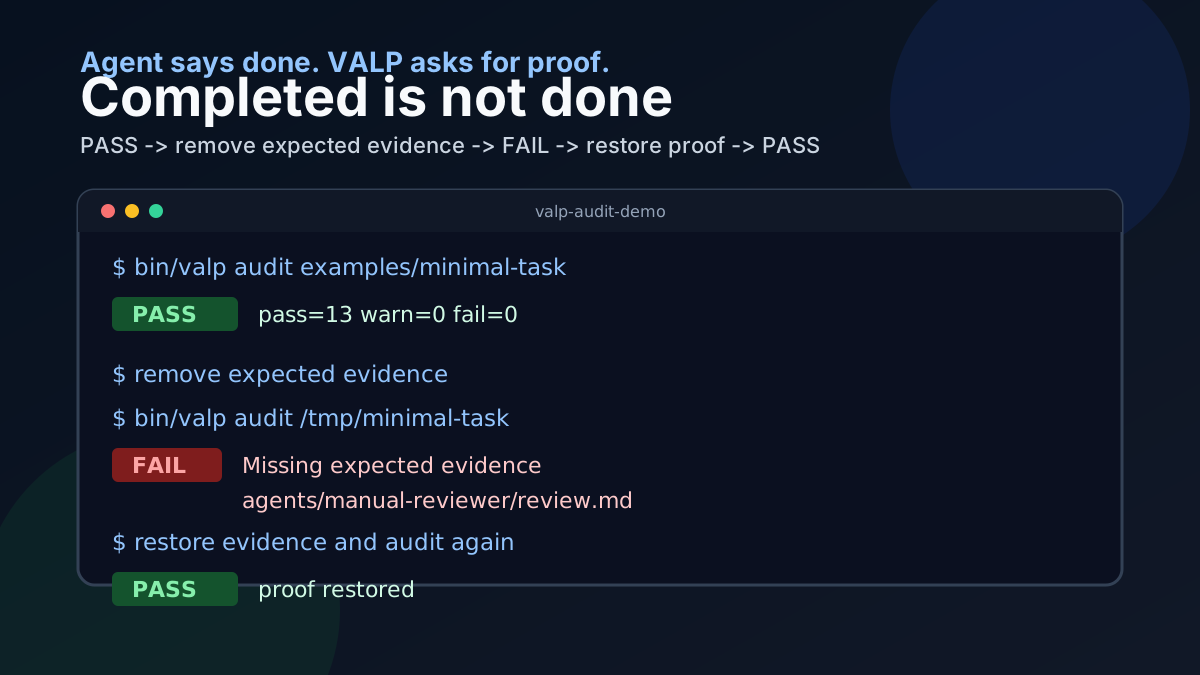
The Smallest Demo
Start with the bundled Manual Mode task:
git clone https://github.com/wcqxgjy6d8-pixel/Visible-Agent-Loop-Protocol.git
cd Visible-Agent-Loop-Protocol
python -m pip install -r requirements-dev.txt
bin/valp audit examples/minimal-task
Expected result:
VALP audit: PASS
Summary: pass=13 warn=0 fail=0
Now copy the task and remove the expected review evidence:
demo_dir="$(mktemp -d /tmp/valp-demo.XXXXXX)"
cp -R examples/minimal-task "$demo_dir/minimal-task"
mv "$demo_dir/minimal-task/agents/manual-reviewer/review.md" \
  "$demo_dir/minimal-task/agents/manual-reviewer/review.md.bak"

bin/valp audit "$demo_dir/minimal-task"
Expected result:
VALP audit: FAIL
Summary: pass=12 warn=0 fail=1

[FAIL] expected_evidence: Expected evidence exists
  Missing expected evidence: agents/manual-reviewer/review.md
Restore the evidence:
mv "$demo_dir/minimal-task/agents/manual-reviewer/review.md.bak" \
  "$demo_dir/minimal-task/agents/manual-reviewer/review.md"

bin/valp audit "$demo_dir/minimal-task"
Expected result:
VALP audit: PASS
Summary: pass=13 warn=0 fail=0
What This Shows
The task did not fail because a model was weak. It failed because the expected proof was missing.
That is the core VALP rule:
Runtime completed != VALP done
Completion needs:
- visible dispatch;
- receipt state;
- expected evidence;
- verification or review;
- approval when the task is high risk;
- final synthesis that cites proof.
What To Critique
If this protocol is useful, it should catch failures that real agent workflows actually produce. The best critique is a concrete case:
- an agent said done but no file changed;
- a runtime marked completed before evidence existed;
- text was inserted into a pane but not submitted;
- review advice was ignored by the coordinator;
- a queue job finished but no expected refs were written.
Post examples or objections here:
Start with the failure gallery or the runtime adapter checklist.